Before the marine chronometer, the sea was a place of fundamental uncertainty. A navigator could determine latitude — his position north or south of the equator — with relative ease, using the angle of the sun at noon or the altitude of Polaris at night. But longitude, his position east or west, was another matter entirely. It required knowing the precise time at a fixed reference point while simultaneously observing local time from the sun. The difference between the two times, multiplied by fifteen, gave the degrees of longitude. Simple in theory. For centuries, impossibly difficult in practice.
The difficulty was the clock. At sea, in the eighteenth century, there was no timepiece capable of maintaining its accuracy through weeks of ocean passage, through the rolling and pitching of a ship, through extremes of temperature and humidity, through the salt air that corroded every metal surface it touched. The pendulum clock, the most accurate timekeeping instrument of the age, was useless at sea — its pendulum disrupted by every wave. Without a reliable clock, longitude remained a matter of estimation and dead reckoning, and dead reckoning killed sailors in large numbers.
The Longitude Prize
The problem was so serious, and so widely understood, that the British Parliament established the Board of Longitude in 1714, offering a prize of £20,000 — equivalent to several million pounds today — for a method of determining longitude at sea to within half a degree. The prize attracted astronomers, mathematicians, and clockmakers from across Europe. Most of the serious scientific establishment favoured a lunar-distance method, using the moon's position against the fixed stars as a celestial clock. The clock solution was widely considered impractical.
John Harrison disagreed. A self-taught Yorkshire carpenter and clockmaker, Harrison spent forty years of his life building, testing, and refining timekeepers capable of surviving the sea. His first three marine timekeepers — H1, H2, and H3, built between 1730 and 1759 — were large, complex machines of considerable ingenuity. They maintained their accuracy through a system of counterbalancing mechanisms that compensated for the ship's motion. But they were heavy, expensive to make, and difficult to replicate.
"He gave every nation the means of traversing the ocean with certainty. He was the Ptolemy of modern astronomy, for he gave the world a fixed point from which to measure."— Thomas Reid, A Treatise on Clock and Watch Making, on John Harrison
H4: The Watch That Changed Navigation
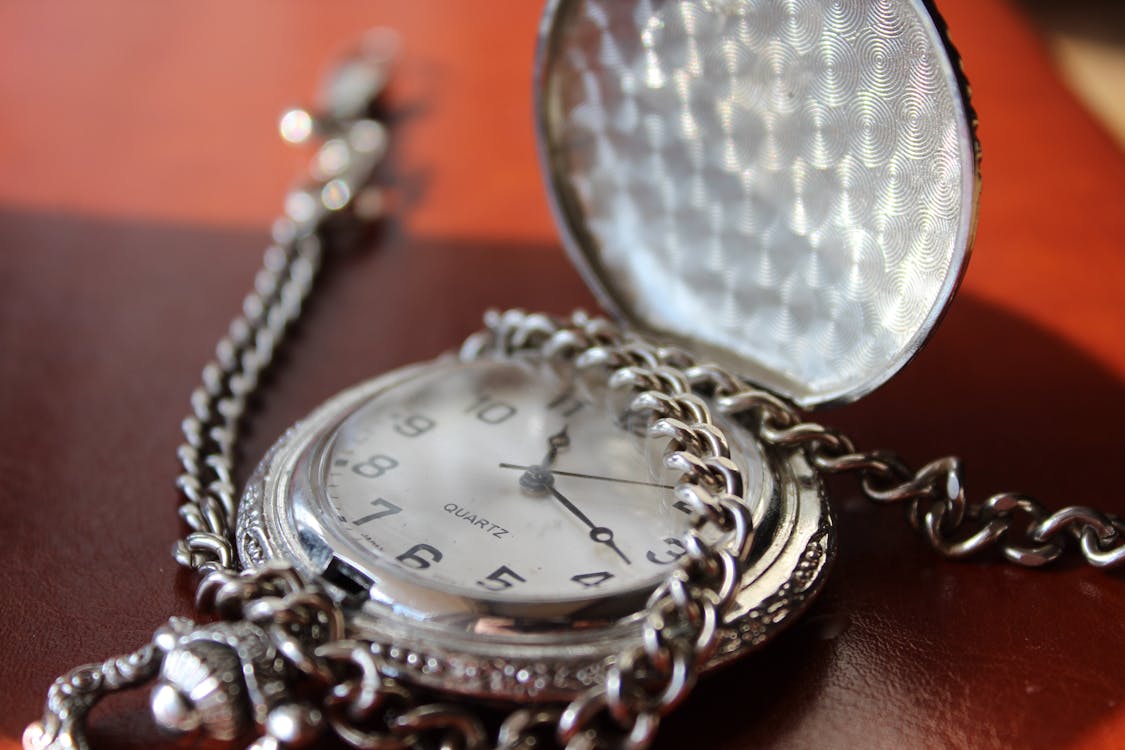
H4, completed in 1759, was something different. Where its predecessors were the size of clocks, H4 was the size of a large pocket watch — 13 centimetres in diameter, beautifully crafted, with a white enamel dial and a fusee movement of extraordinary precision. It used a novel temperature-compensated balance spring and a modified verge escapement adapted for the marine environment. On its trial voyage to Jamaica in 1761, H4 lost only five seconds over 81 days. This was an error of less than a mile in longitude — far within the terms of the prize.
The Board of Longitude, dominated by astronomers who had invested decades in the lunar-distance method, refused to accept the result without further trials. Harrison, by now in his seventies, endured another decade of testing and bureaucratic obstruction before King George III intervened and Parliament awarded him most of the prize money in 1773. He never received the full £20,000, and the Board never formally acknowledged the prize had been won. It is one of the more ignoble episodes in the history of British institutions.
From Instrument to Industry
H4's influence, however, was immediate and transformative. Larcum Kendall, a London clockmaker, was commissioned to make a copy — K1 — which sailed with Captain James Cook on his second and third Pacific voyages. Cook praised it in terms that would have gratified Harrison: "Our trusty friend the Watch," he called it, "our never failing guide."
The marine chronometer that emerged from Harrison's work, refined and made replicable by makers including Thomas Mudge, John Arnold, and Thomas Earnshaw over the following decades, became standard equipment on every ocean-going vessel. By the mid-nineteenth century, British ships typically carried three chronometers, so that discrepancies could be detected by comparison. The gimballed brass box, suspended so that the movement remained level regardless of the ship's motion, became one of the most recognisable objects in navigation.
The consequences extended far beyond navigation. Reliable longitude made possible accurate mapping, which made possible the colonial enterprise in all its complexity, which made possible the modern world's political geography. The marine chronometer is, in this sense, one of the most consequential objects ever made — a timekeeper that did not merely measure time but reorganised space.
The Legacy in Metal
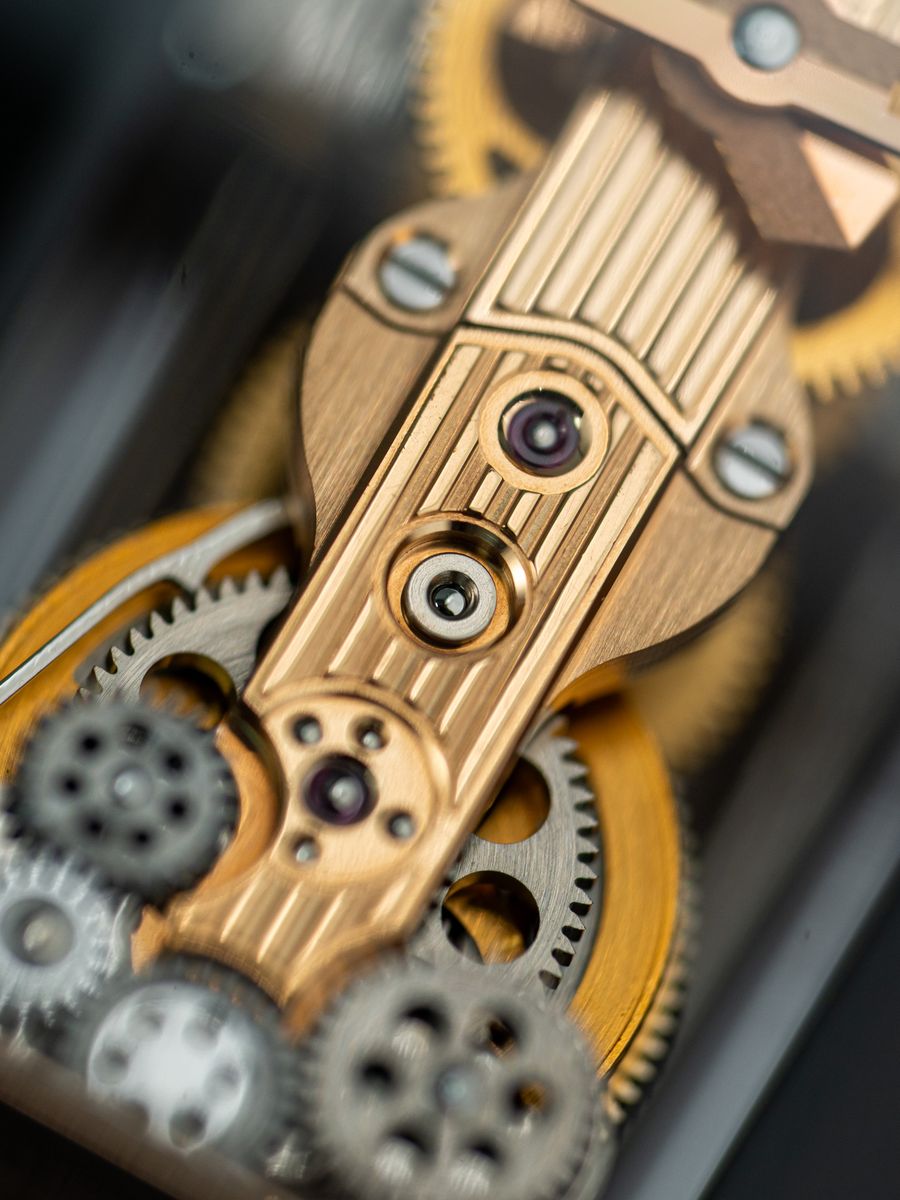
The marine chronometer's technical inheritance is visible throughout fine watchmaking today. The temperature-compensated balance, the detent escapement (used in many chronometers for its low-friction characteristics), the fusee and chain for equalising mainspring power — all of these were developed or refined in the pursuit of seagoing precision. When a modern watchmaker speaks of rate accuracy in terms of seconds per day, they are measuring against a standard whose ultimate origin is the demand, issued by the Admiralty in the eighteenth century, for a clock that could tell a captain where he was in the middle of the ocean.
H4 itself can be seen today at the Royal Observatory, Greenwich — small, beautiful, and improbably significant. It sits in its case looking like exactly what it is: an old watch. It does not look like the object that changed the world's relationship with space and time. But then, the most consequential things rarely do.